Evaluating a supplier network in China requires more than collecting company names. Buyers need to understand which entity contracts and invoices, where each production step takes place, how quality information moves between sites, and who has authority to approve changes. A risk-based map makes capacity, commercial incentives, records, and supplier approval boundaries easier to review before and during an order.
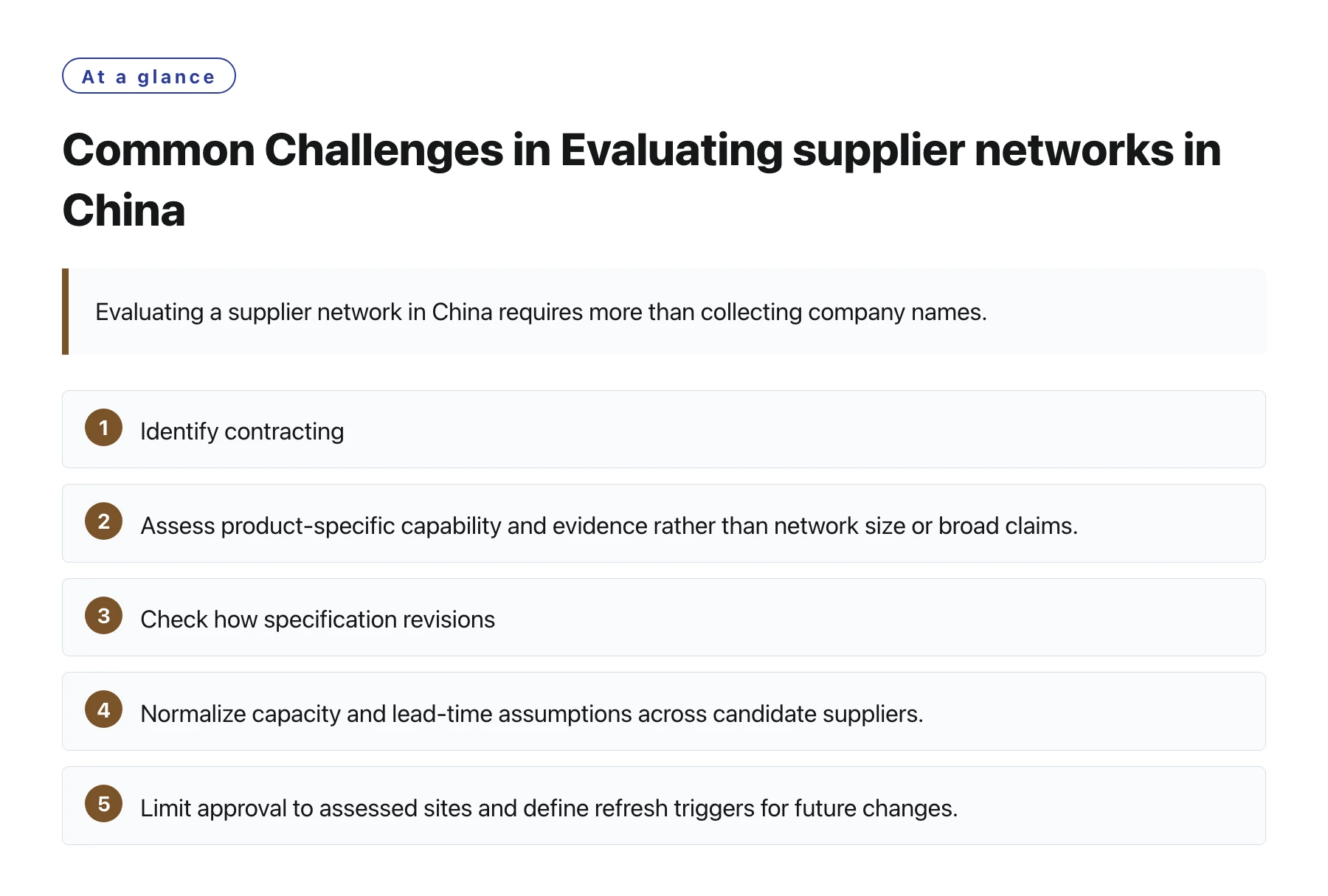
Key takeawaysIdentify contracting, invoicing, manufacturing, and subcontracting entities separately. · Assess product-specific capability and evidence rather than network size or broad claims. · Check how specification revisions, traceability, nonconformances, and records travel. · Normalize capacity and lead-time assumptions across candidate suppliers. · Limit approval to assessed sites and define refresh triggers for future changes.
Supplier networks can expand flexibility, but each additional handoff creates a point where requirements, records, or accountability may be lost. Map the path of the product and the decisions that control it.
The supplier name may not reveal the production network
A quotation may come from a trading company, exporter, factory group, or brand owner, while manufacturing takes place at one or more separate sites. Ask which legal entity signs the contract, which company invoices, where the product is made, and who owns release decisions. Record each party’s role instead of treating all names as interchangeable.
Map the product’s path from raw materials to finished goods. Identify subcontracted steps such as coating, assembly, printing, sterilization, or packaging when they affect requirements. Ask who approves subcontractors, how work is transferred, and how records follow the product. A visit to the main office cannot establish control over a production step at an undisclosed site.
Confirm which facility and network will fulfill the specific order. Some suppliers use several plants or switch production based on capacity. The purchase specification should identify the approved site and define notice, evidence, and approval requirements before production moves elsewhere.
A wide supplier list is not the same as a qualified network
Networks can contain many names with overlapping capabilities, but the buyer needs evidence of product fit. For each candidate, record relevant machinery or process capability, product examples, capacity assumptions, quality controls, location, and open questions. Separate what was directly verified from what a supplier or intermediary reported.
Use the same qualification criteria for candidates offering the same work. Evaluate the exact process and product category rather than relying only on company size, years in business, or a broad certificate. ISO describes ISO 9001 as a quality management system requirements standard that organizations can use to manage and improve processes; certification is not mandatory and does not itself establish product conformity.[1]
Prioritize checks according to risk and decision value. A low-risk standard item may need a document review and sample. A custom or regulated item may require a deeper process assessment, traceability review, or qualified market-specific evaluation. A checklist should help allocate scrutiny, not automatically approve every supplier that completes it.
Commercial relationships can obscure incentives
Ask how the sourcing provider, trading intermediary, factory, and sales representative are paid and whether any party receives commissions, rebates, or referral fees. Document the answer and determine whether independent quotations, disclosure, or extra oversight is needed. The presence of an incentive does not prove misconduct, but hidden compensation can make recommendations difficult to assess.
Confirm that purchase orders, invoices, payment instructions, and manufacturing records identify compatible entities. If payment goes to an entity different from the contracting party, require a clear explanation and review the legal and financial implications. Independently verify account changes through a known contact channel.
Clarify who owns tooling, drawings, molds, test fixtures, and product data. A network may split design, production, and export roles among several companies. The buyer should document access and transfer rights before investing in assets or relying on one intermediary to retain critical records.
Capacity claims can be difficult to compare
Ask suppliers to define capacity in the units and period that matter: shifts, equipment, labor, yield assumptions, product mix, and current commitments. A statement such as can produce 10,000 units monthly is hard to evaluate without knowing whether it refers to one process, a family of products, or theoretical equipment output.
Check whether quoted lead time begins after deposit, approved sample, material availability, or another milestone. Ask which components are long-lead and which steps depend on subcontractors. For a network with multiple sites, determine whether work can be moved and what requalification or buyer approval would be required.
Use a production schedule and milestone evidence to validate commitments after award. Track material readiness, start date, in-process checks, finished quantity, and cargo-ready date. If a supplier misses a milestone, record the cause and mitigation rather than replacing the planned date with a fresh estimate without history.
Quality information may not travel between network members
Confirm which party owns the current specification and how revisions reach every production and inspection site. Ask how obsolete drawings are withdrawn and how workers identify the active version. A network can appear coordinated while one subcontractor continues using an older print or test method.
Trace a finished lot through material sources, production records, inspections, packaging, and shipment documents. Identify who can retrieve each record and within what agreed response time. If one firm holds the data for another, define access rights and continuity if the relationship ends.
Agree how nonconforming output and corrective actions are shared. A defect discovered at a subcontractor should reach the responsible supplier and buyer before the next process or shipment. Define containment, impact assessment, owner, due date, and closure evidence for the network as a whole.
Approvals need boundaries and refresh triggers
Limit supplier approval to the product, site, process, and scope actually assessed. State whether alternate sites, subcontractors, materials, or tooling are included. A quality certificate covering one company does not automatically qualify every related company or facility in the commercial network.
Set refresh triggers such as a facility change, new subcontractor, repeated nonconformance, capacity shift, ownership change, or significant process modification. Review performance records and due diligence at intervals appropriate to risk. Keep a dated approval record with evidence references and conditions.
When evaluating a supplier network in China, buyers may compare a sourcing company in China against their own needs for supplier discovery and coordination. Confirm which entities and sites it can identify or monitor, what records it provides, and who retains final supplier, technical, quality, and regulatory decisions.
Sources
Frequently asked questions
What is the first step in evaluating a supplier network?
Identify the contracting and invoicing entities, actual production sites, and subcontracted steps for the product. Then compare each party’s responsibilities with the order requirements.
Does a quality-system certificate qualify every site in a supplier group?
No. Review the legal entity, site, scope, and covered activities. Limit buyer approval to the product and locations actually assessed.
How can capacity claims be compared?
Ask for the production basis, period, shifts, equipment, product mix, existing commitments, and lead-time start condition. Validate key milestones after award.
When should a supplier network be reassessed?
Review material changes such as site or subcontractor changes, recurring quality issues, process changes, ownership changes, or shifts in capacity and product scope.