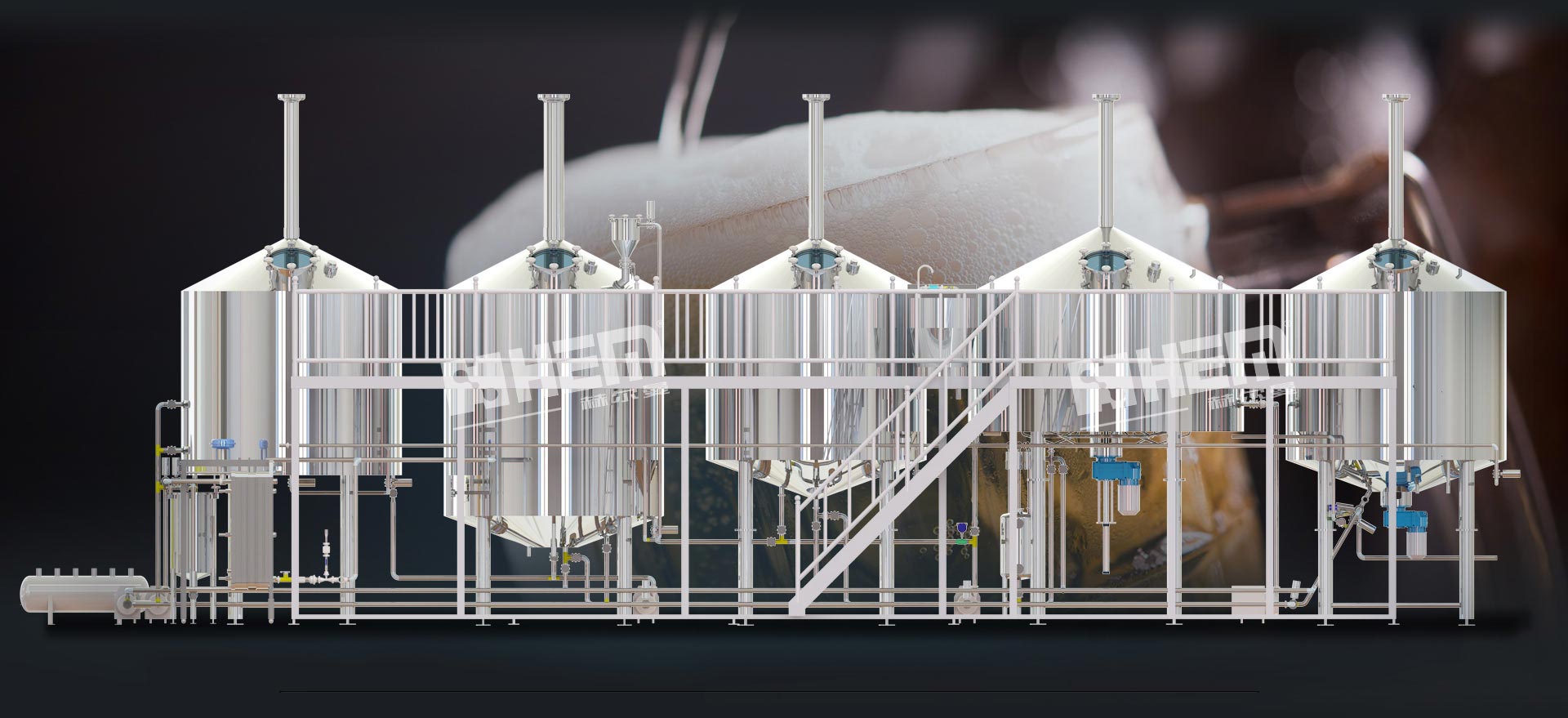
The hem brew system is built around measurable brewery needs: batch capacity, heat transfer, process control, sanitation, and repeatable production. Available configurations range from 1 HL to 500 HL, while smaller 300 L systems are specified for 1–2 brews per day and commercial configurations can reach 2–3 brews per day. Depending on configuration, brewers can choose electric, steam, or direct-fire heating plus PID, semi-automatic PLC, or fully automatic PLC control. Specified heat-transfer efficiency can reach at least 90% on selected systems, while internal polishing is listed at ≤0.4 μm, helping combine production speed with cleanable stainless-steel surfaces.
Brewhouse efficiency starts with matching equipment capacity to the amount of beer a brewery actually plans to produce. Hermann lists systems from 1 HL to 500 HL, with 2-vessel, 3-vessel, and 4-vessel layouts available for different production schedules. A 300 L setup is specified for 1–2 brews per day and requires about 35 m² of working area, while a 500–800 L setup uses about 55 m². Moving to a 1,000 L configuration raises the listed working-area requirement to about 90 m².
Capacity alone does not determine daily output because vessel arrangement affects how quickly one brewing stage can release equipment for the next. A 10 bbl 2-vessel brewhouse is listed for 1–2 brews per day, whereas a 20 bbl 3-vessel configuration is specified for 2–3 brews per day. Separating more process stages across vessels can reduce waiting between mash, lauter, kettle, and whirlpool work when a brewery needs several turns within the same production day.
A brewery producing two 1,000 L batches instead of one moves 100% more nominal wort volume through the brewhouse that day, provided fermentation capacity, cooling, staffing, cleaning, and utilities can support the second batch.
Higher daily throughput makes heating performance more important because water and wort account for a large thermal requirement. The American Homebrewers Association gives an example in which heating 26.5 L of water from 16°C to boiling requires about 9,400 kJ before practical system losses are considered. Scale the same physics to hundreds or thousands of liters and insulation, heat-exchange area, heating power, and temperature control become significant parts of the production schedule.
The hem brew system addresses different utility conditions with electric, steam, and direct-fire heating options. Published specifications list 12 kW for a 300 L system, 15–40 kW for 500–800 L equipment, and 25–80 kW for a 1,000 L setup. The manufacturer also states heat-transfer efficiency of ≥90% for its 10–30 HL craft brewery range. Actual energy consumption still depends on recipe, starting water temperature, boil duration, insulation, ambient conditions, and production volume.
| Equipment example | Published capacity / specification | Production-related figure |
|---|---|---|
| Small system | 300 L | 12 kW; 1–2 brews/day |
| Small system | 500–800 L | 15–40 kW; 1–2 brews/day |
| Brewhouse | 1,000 L | 25–80 kW; 1–2 brews/day |
| Craft system | 10–30 HL | ≥90% stated heat-transfer efficiency |
| 20 bbl, 3 vessels | 20 bbl | 2–3 brews/day |
Temperature control becomes the next consideration once sufficient heating capacity is available. The American Homebrewers Association uses a typical all-grain example with strike water at 70–72.2°C, an 8–12°F temperature decrease after grain addition, a mash target of 65.6°C, and a 60-minute mash. A brewhouse therefore needs more than enough power to heat water; operators also need predictable measurement and control during temperature-sensitive stages.
Hermann offers PID display panels, semi-automatic PLC touch-screen controls, and fully automatic PLC controls, depending on configuration. PLC control can standardize timed stages, pump operation, heating sequences, and repeat settings between batches when the system is configured for those functions. A brewer producing the same pale ale 50 times has more use for repeatable settings than a process requiring operators to reconstruct temperature and timing procedures on every brew.
Repeatability also makes deviations easier to find: if a 60-minute mash normally reaches the expected gravity but one batch does not, recorded time, temperature, flow, and ingredient data give the brewer a smaller set of variables to check.
Extraction provides another measurable view of efficiency. In February 2026, the Brewers Association reported that breweries operating below 80% mash and lautering extract efficiency can have substantial room for improvement. Its benchmarking material also notes that a 10% increase in extract efficiency could equal approximately one fewer bag of malt per batch in an applicable brewing example.
Equipment cannot create extract by itself because malt specification, crush, mash chemistry, temperature, water-to-grist ratio, lautering practice, and recipe design all matter. Equipment can, however, provide controlled conditions for improving those variables. A stable mash temperature, suitable vessel geometry, controllable pumps, and repeatable lautering procedures make it easier to compare batch results rather than changing several operating conditions at once.
Thermal stability becomes especially relevant when batch size changes. American Homebrewers Association testing reported roughly a twofold increase in heat-loss rate when comparing a mash-lauter tun filled to about one-third with one filled nearly to the rim. Lower-volume batches have less thermal mass relative to their surroundings, so a brewery regularly producing partial batches needs to consider how vessel utilization affects temperature retention rather than assuming a 30% fill behaves like a 90% fill.
That relationship connects vessel sizing with production planning. Buying a brewhouse much larger than normal batch demand may provide future capacity but can alter working depth, thermal behavior, cleaning requirements, and facility use during smaller runs. Hermann states that approximately 300–500 ft² may be needed for 3–5 bbl equipment and about 550–1,200 ft² for 7–15 bbl equipment, although final requirements depend on the brewery layout and supporting equipment.
Facility planning also has to account for height, drainage, electricity, water, air, and CO₂. Hermann lists a preferred 4-inch floor drain for small and craft systems; its 1–10 HL range calls for roughly 10.5 ft of ceiling height, while 10–30 HL equipment calls for approximately 12.5 ft. Electrical options include several three-phase voltages and frequencies, with configuration depending on installation requirements. Checking those figures before equipment purchase can prevent expensive utility changes after tanks arrive.
Cleaning adds another layer because brewing time is only part of equipment occupancy. Grain residue, wort, protein, hop material, and soil remaining on surfaces have to be removed before sanitation. The American Homebrewers Association notes that debris left on brewing equipment can harbor microorganisms even when sanitation is performed afterward, so cleanability affects both turnaround time and product control.
Hermann specifies TIG 100% full-welded joints and polishing accuracy of ≤0.4 μm for listed brewhouse equipment. Smoother product-contact surfaces are useful in hygienic processing because there are fewer rough areas where soil can remain, although cleaning performance still depends on tank geometry, spray coverage, chemical concentration, temperature, contact time, and operator procedure. The company also offers CIP equipment as part of complete brewery configurations.
If cleaning occupies 60 minutes in a five-hour brewhouse cycle, it accounts for 20% of equipment time. Cutting that stage to 45 minutes reduces total cycle time by 5%, even when mash and boil durations stay unchanged.
Water use should be measured with the same care. Beer itself is roughly 95% water, according to the American Homebrewers Association, while a working brewery also consumes water for mash preparation, sparging, rinsing, vessel cleaning, floors, hoses, and other sanitation work. The Brewers Association maintains benchmarking resources specifically for breweries seeking to reduce water, wastewater, solid waste, and total energy use.
A practical assessment therefore records liters of water per liter of packaged beer rather than looking only at recipe water. The same approach works for electricity in kWh per batch, malt in kilograms per hectoliter, active labor hours per brew, brewhouse yield, extract efficiency, and cleaning minutes. Comparing 20 or 50 batches under the same measurement method provides a more useful operating picture than judging performance from one unusually smooth production day.
Maintenance and equipment testing matter once production becomes repetitive. Hermann states that tank manufacturing goes through five inspection stages, including incoming material checks, production inspection, jacket pressure testing, finished-product inspection, and packing/loading inspection. Its published procedure lists jacket testing at 5 bar, internal shell testing at 4 bar, 12-hour air-and-water testing, and an additional 48-hour water test before packing.
Material specification supports that production approach. The manufacturer lists stainless steel 304 or 316 among its tank materials and describes 3 mm and 2 mm plate specifications for applicable construction. Material grade, weld finish, pressure rating, gasket selection, valve design, and surface condition should still be checked against the exact quotation and technical drawing because a 300 L restaurant brewhouse and a 20 bbl commercial installation do not operate under identical requirements.
Production planning finally comes back to matching the brewhouse with downstream capacity. A system capable of 2–3 brews per day cannot sustain that rate when every fermenter is occupied, glycol capacity is insufficient, or the cellar cannot accept another batch. A 20 bbl brewhouse running three turns can produce up to 60 bbl of nominal wort in a day, so fermentation tank volume, cooling capacity, yeast handling, CIP scheduling, and packaging availability need to be sized around that potential flow rather than the brewhouse nameplate alone.
For breweries comparing equipment in 2026, useful purchase specifications are therefore measurable: liters or barrels per batch, brews per day, heating kW, heat-exchange area, available control level, floor area, ceiling height, surface finish, pressure-test records, and utility requirements. Hermann’s published examples range from a 300 L, 12 kW installation with 0.45 m² of heat-exchange area to larger commercial systems with multiple vessels and substantially higher power requirements, giving operators figures they can compare with planned annual volume, available utilities, staffing, and cellar capacity before selecting a configuration.